
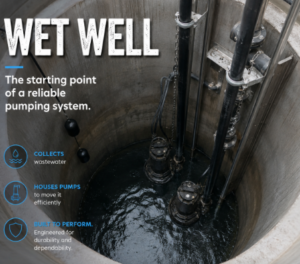
When people think about sewage pumping systems, they usually focus on the pumps—but there’s another essential component working quietly behind the scenes: the wet well.
A wet well is the underground chamber where wastewater is collected before it is pumped to its next destination, such as a treatment works or the main sewer network. Think of it as a temporary holding tank that keeps wastewater flowing efficiently and safely.
HOW DOES A WET WELL WORK?
🚰 Wastewater flows into the wet well through gravity
📈 As the water level rises, level sensors or float switches monitor the depth
⚙️ Once the water reaches a predetermined level, the pumps automatically switch on and transfer the wastewater out through the rising main
✅ When the level drops, the pumps stop, ready for the next cycle
WHY ARE WET WELLS SO IMPORTANT?
A well-designed wet well helps to:
✅ Prevent flooding and sewage overflows
✅ Maintain efficient pump performance
✅ Reduce unnecessary pump starts, extending equipment life
✅ Minimise blockages by promoting smooth flow
✅ Improve the reliability of the entire pumping station
DESIGNING THE RIGHT WET WELL
Not all wet wells are the same. Factors such as size, shape, inlet configuration, pump selection, and ventilation all play a crucial role in ensuring long-term performance.
Poorly designed wet wells can lead to:
❌ Pump clogging
❌ Odour problems
❌ Sediment build-up
❌ Increased maintenance costs
❌ Reduced pump lifespan
Investing in the correct wet well design from the outset can significantly reduce operational costs and improve system reliability for years to come.
THE BOTTOM LINE
A sewage pumping system is only as effective as the wet well it operates from. While it may not be the most visible part of the infrastructure, it plays a vital role in protecting properties, supporting wastewater networks, and keeping communities running smoothly.
A properly designed wet well doesn’t just hold wastewater—it helps your entire pumping system perform at its best.
📧 strate@cougar-industries.co.uk
📞 01442 860000
@2026